
The New Snowbird Reality: Navigating the U.S. 30-Day Rule, Tax Implications , and more

For generations, the winter ritual for hundreds of thousands of Canadian retirees was delightfully simple: pack the car, head south across the border, and spend six uninterrupted months basking in the warmth of Florida, California, or Arizona.

However, the classic snowbird lifestyle has fundamentally shifted. Driven by soaring inflation, a volatile exchange rate, and a historic tightening of U.S. border regulations, the days of casual, paperwork-free winter migrations are officially over.

To safely chase the sun today, senior travellers must successfully navigate a strict new web of U.S. immigration mandates, complex IRS tax formulas, and rigid travel insurance policy conditions. Here is what you need to know to protect your health, your wallet, and your ability to travel freely.
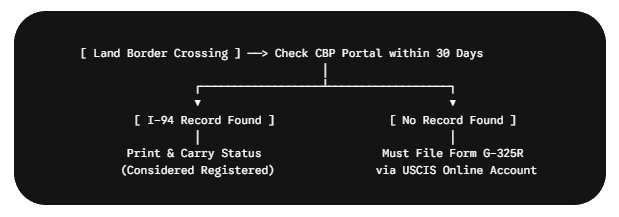
The biggest disruption to the winter migration routine stems from a massive shift in U.S. border enforcement. Under Section 262 of the Immigration and Nationality Act (INA)—reinvigorated by recent executive actions—the U.S. government is actively enforcing a strict tracking policy for all non-citizens.

If you enter the United States and intend to stay for 30 days or longer in a single visit, you are now legally required to be registered with the U.S. government. How you comply depends entirely on how you crossed the border:

  • By Air or Sea:Form I-94
  • By Land or Ferry: If you drive across the border, an electronic I-94 is rarely issued automatically.

Because of this gap, land-border travellers face a hidden trap. Failing to register or carry proof of registration is a federal misdemeanor that carries civil fines up to $5,000, potential deportation, or even jail time.

Crucial Action Step: Within your first 30 days across the border, log onto the official U.S. Customs and Border Protection (CBP) portal (i94.cbp.dhs.gov). Click "Get Most Recent I-94" and enter your details. If your latest trip appears, you are safe—print it out and carry it. If no record is found, you must immediately create a USCIS online account and submit Form G-325R (Biographic Information Registration) electronically before your 31st day. Note: Canadians are currently exempt from the biometric fingerprinting requirement.

Do not confuse immigration limits with tax laws. While U.S. immigration generally allows Canadians to visit for up to six months, the IRS uses a much tighter, weighted calculation called the Substantial Presence Test (SPT) to determine if you owe them money.

The IRS calculates your presence by adding:

  1. 100% of the days you spent in the U.S. during the current year.
  2. One-third (33.3%) of the days from the previous year.
  3. One-sixth (16.6%) of the days from the year before that.

If this three-year weighted sum equals or exceeds 183 days, the IRS legally views you as a resident alien for tax purposes. This means your global income could be subject to U.S. taxation. To demonstrate Canadian taxation ties , any snowbird spending more than 120 days south of the border annually must proactively file IRS Form 8840 (Closer Connection Exception) by June 15th every year to prove their primary economic and social ties remain in Canada.

With U.S. grocery prices climbing and the Canadian dollar facing ongoing headwinds, the financial reality of traditional American hotspots is forcing many senior travellers on fixed incomes to re -evaluate their options.

A major shift is underway as Canadian snowbirds look globally for affordable winter havens:

Swipe to view more

Destination
Average Monthly Living Cost
Primary Appeal
Legal Catch
The Sunbelt (US) High ($3,500 - $5,000+ USD) Driving distance, familiar culture, English language. Strict 30-day USCIS registration and IRS day tracking.
Mexico (Chapala/Merida) Low ($1,500 - $2,500 USD) Massive established expat communities, cheap private medical care. 180-day tourist cap; requires flying or driving through complex transit zones.
Portugal (The Algarve) Moderate ($2,000 - $3,200 USD) Exceptionally safe, affordable European coastal living, widely spoken English. Schengen Zone limits Canadians to 90 days out of any 180-day window without a visa.

While switching to Europe or Mexico can drastically stretch your retirement dollar, keep in mind that it eliminates U.S. tax exposure only to replace it with entirely separate foreign visa frameworks.

No matter where you choose to winter, your physical health remains your most critical asset—and your greatest financial liability. Provincial healthcare plans (such as OHIP or MSP) limit how long residents can be outside their home province/country before coverage eligibility is affected, and they generally cover only a very small portion of emergency medical costs incurred outside Canada, particularly in the U.S.1

While most snowbirds know they must purchase private travel medical insurance, thousands unknowingly invalidate their policies every year due to a complete misunderstanding of the Stability Clause.

Insurance companies do not automatically deny you coverage if you have a pre-existing medical condition, like high blood pressure, cholesterol, or diabetes. Instead, they require that the condition be strictly "stable" for a specific period—typically 90 to 180 days—immediately before your departure date.

A condition is legally classified as unstable if, during that window, you experienced:

  • Any new symptoms, minor or major.
  • Any new medical consultations, tests, or pending specialist referrals.
  • Any change in prescription medication.

This final point is where most seniors can be caught unaware. If your family physician decreases your blood pressure dosage from 10mg to 5mg two months before you leave, or switches you to a generic equivalent to save you money, your condition is technically "unstable." If you suffer a related medical emergency while abroad, your insurer may legally deny a multi-million dollar hospital claim entirely.

This article is intended for general informational purposes only and does not constitute legal, medical, financial, or other professional advice. Allianz Global Assistance is not responsible for the use of external websites or applications, or the content or accuracy of external information or technologies.


Related articles
Travel protected with Allianz Global Assistance
Or call us at 1-844-310-1578 
to speak with one of our agents.
Join our Community of Travellers!­
Get great travel tips, updates and news straight to your inbox with our monthly eNewsletter.

Warning - The E-Mail Address configured for this form is either unverified or invalid. Please verify the E-Mail Address and try again later.

A verification E-Mail was sent to the following E-Mail addresses:

Kindly check the corresponding inbox for a verification E-Mail and verify it.

Click the "Submit" button to sign up for this eNewsletter - you can unsubscribe at any time.